
Table of Contents
The Problem with the 1X2 Market
The vast majority of casual football bets are placed on the traditional Match Winner (1X2) market: Home Win, Draw, or Away Win. Statistically, football has a high frequency of draws (historically around 25% to 30% depending on the league). When you bet on a team to win in the 1X2 market, you instantly forfeit your entire stake if the match ends in a draw.
Furthermore, bookmakers typically take a higher margin (the "vig" or "juice") on 1X2 markets, often around 5-7%. Asian Handicap markets were designed to eliminate the draw entirely, reducing the game to a coin-flip proposition with much lower margins (often around 1.5% to 3%). Sharp bettors and AI models operate almost exclusively in Asian Handicap markets because the margins are tighter and the variance is reduced.
Understanding Asian Lines
The core concept of the Asian Handicap is that a virtual "handicap" is applied to the final score to level the playing field between a heavy favorite and an underdog.
Whole and Half Goals
-1.0 / +1.0: If you bet on Team A at -1.0, they must win by 2 or more goals for you to win the bet. If they win by exactly 1 goal, the handicap score is a draw, and your stake is fully refunded (a "push"). Team B at +1.0 wins if they draw or win the match, and pushes if they lose by exactly 1.
-1.5 / +1.5: Here, the possibility of a push is eliminated. Team A must win by 2 or more goals. If they win by 1 goal, draw, or lose, the bet on Team A loses. Team B wins the bet if they lose by 1 goal, draw, or win.
How AI Prices Asian Handicaps
Pricing an Asian Handicap requires complex mathematical modeling. It is not enough to know who will win; the AI must calculate the exact distribution of the margin of victory.
Goal Supremacy and Monte Carlo Simulations
Machine learning algorithms first calculate a metric known as "Goal Supremacy." By comparing the Expected Goals (xG) metrics, defensive capabilities, and game state adjustments of both teams, the AI might determine that Manchester United is 1.35 goals better than Everton on a neutral pitch. After adjusting for home-field advantage and recent injuries, the final Goal Supremacy might be 1.60.
The AI then uses Monte Carlo simulations to play the match 100,000 times based on these underlying supremacy ratings. The output is a probability matrix showing exactly how often United wins by 1 goal, by 2 goals, by 3 goals, how often the match is a draw, and how often Everton wins.
By summing these probabilities, the AI can independently price every single Asian Handicap line offered by the bookmaker.
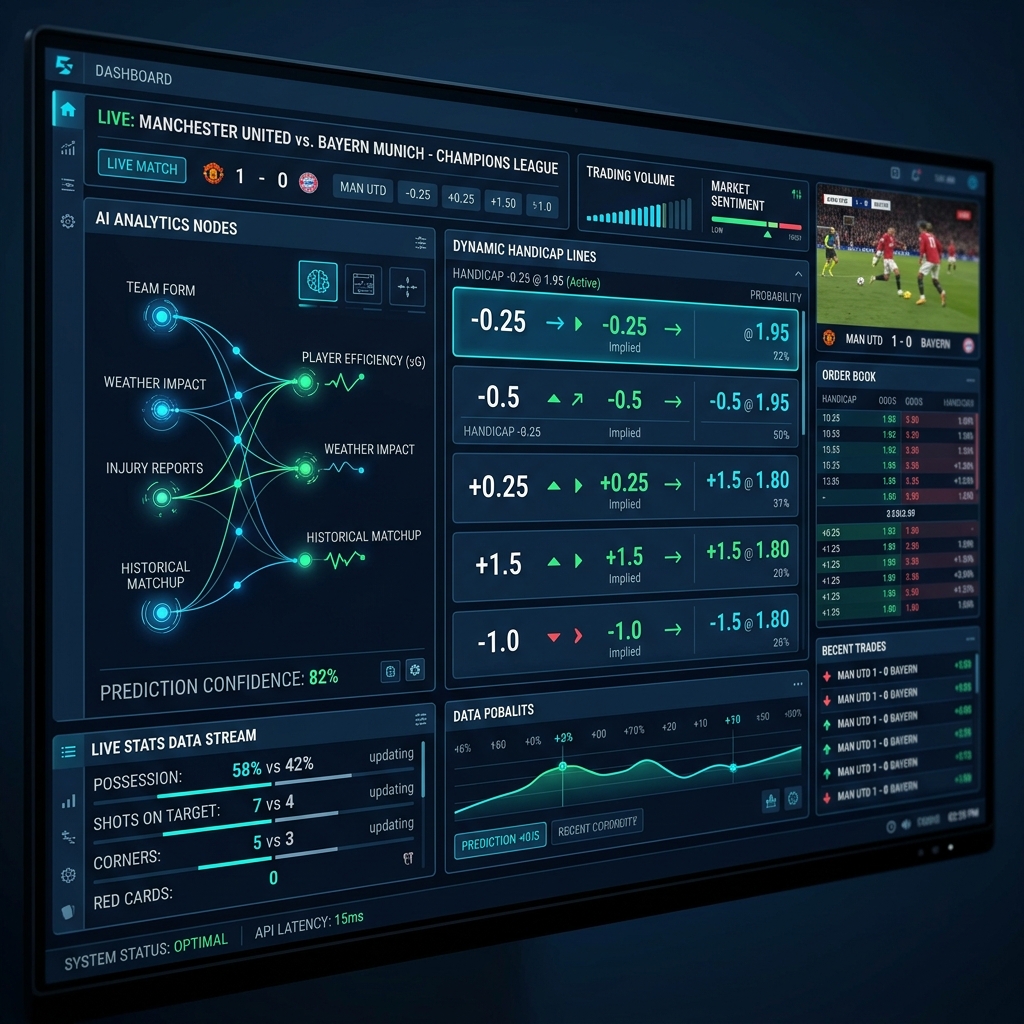
The Power of Split Lines (e.g., -0.25, -0.75)
The true brilliance of the Asian Handicap system lies in "Quarter" or "Split" lines. These lines split your stake in half between the two nearest quarter intervals.
Example: The -0.25 Line
If you bet $100 on Team A at -0.25, your bet is split: $50 is placed on Team A at 0.0 (Draw No Bet) and $50 is placed on Team A at -0.5 (To Win).
- If Team A wins: Both halves of your bet win.
- If Team A loses: Both halves of your bet lose.
- If the match is a Draw: The -0.5 half loses ($50), but the 0.0 half is refunded (Push). You lose half your stake rather than your entire stake.
Why AI Loves Split Lines
AI models love split lines because they provide mathematical insurance. If a machine learning algorithm calculates that a team has a 45% chance of winning, but a massive 35% chance of drawing (perhaps due to two highly defensive, low-tempo teams), a 1X2 bet is too risky. However, betting the -0.25 line allows the bettor to capture the value of the win while severely mitigating the risk of the highly probable draw. AI models calculate the Expected Value (+EV) of these partial wins and losses down to the decimal point to identify long-term profitability.
Finding the Edge against the Asian Books
Asian betting syndicates and high-volume brokers (like Pinnacle, SportMarket, and ISN) set the sharpest odds in the world. How does an independent AI model beat them?
Early Market Entry and CLV
The Asian markets are incredibly efficient just before kickoff, absorbing millions of dollars in liquidity. The edge is found early in the week. AI models parse fundamental data (xG, squad rotations, weather forecasts) much faster than the market can react.
If the AI calculates the true line for a match should be -1.0, but the Asian markets open the week at -0.5, the AI flags a massive +EV opportunity. By Friday, the syndicates will have hammered the -0.5 line, moving the market to the correct -1.0 line. The bettor who followed the AI early has secured massive Closing Line Value (CLV).
Isolating Injury and Roster Impacts
Asian handicap lines can shift dramatically based on a single piece of news, such as a star striker being ruled out. Advanced AI models quantify the precise "Value Over Replacement Player" (VORP) for every athlete. If Erling Haaland is injured, a human might guess the line should drop by half a goal. The AI knows exactly, mathematically, that his absence reduces Manchester City's Goal Supremacy by precisely 0.42 goals, allowing the algorithm to instantly identify if the market overreacted or underreacted to the news.
Conclusion: The Professional's Choice
If you want to transition from casual punting to professional, data-driven sports investing, you must abandon the 1X2 market and embrace the Asian Handicap. It reduces bookmaker margins, eliminates the frustration of the draw, and allows for surgical, mathematical risk management.
By pairing your understanding of Asian Handicaps with a sophisticated AI prediction model, you gain the ability to systematically identify mispriced lines, secure CLV, and grind out a consistent, mathematical profit over a large sample size of bets.
Trade Like a Professional
Access mathematically precise Goal Supremacy ratings and +EV Asian Handicap picks powered by advanced machine learning.
View Today's Asian Handicap Picks →