
World Cup 2026:
AI Predictions & Premium Picks

The ultimate hub for algorithm-driven insights. Leverage +EV models and predictive AI for the 48-team mega tournament across the USA, Canada, and Mexico.

World Cup 2026 AI Predictions Cover

The Biggest Betting Opportunity in History

3+ Billion Bettors Global Data

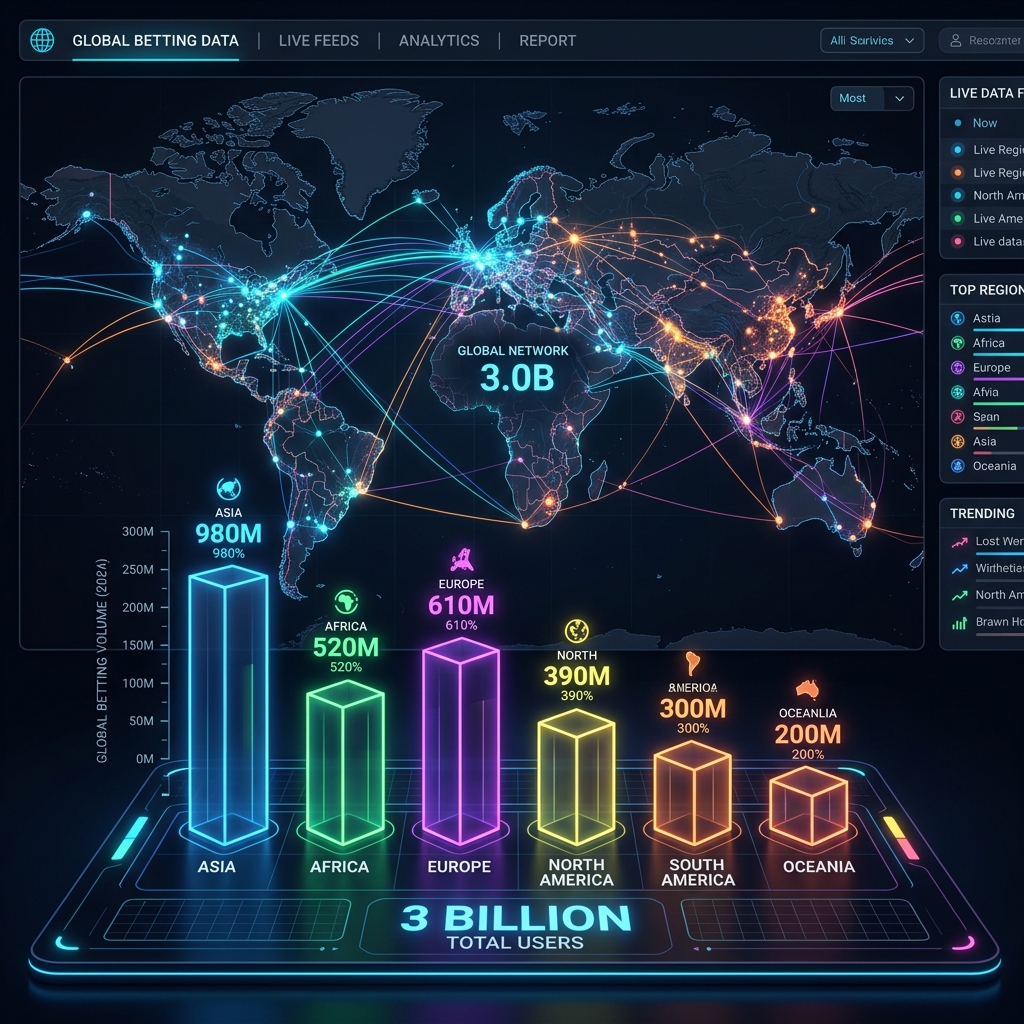
The 2026 World Cup is poised to be the single largest sports betting event in human history. With an estimated global audience exceeding 3.5 billion people, early projections show that over 3 billion people will place a wager at some point during the tournament. This unprecedented volume of money flooding the market represents a golden era for quantitative sports bettors and predictive AI models.

1. The Scale of the 2026 World Cup Betting Market

Traditional sportsbooks are built to handle localized betting action, but the World Cup is a different beast. Hundreds of billions of dollars in liquidity will flow through Asian markets, European exchanges, and US-regulated platforms. For AI models, high liquidity is essential: it allows sharp bettors to place massive wagers without immediately moving the line, and ensures that bet limits remain extremely high across all major bookmakers.

2. Recreational Public Bias: The Sharp Bettor's Playground

The vast majority of the 3+ billion bettors are casual fans who make decisions based on emotion, national pride, and media hype rather than mathematical probability. This creates a highly distorted market:

  • Heavy Favorite Over-Betting: Casual money disproportionately backs traditional powerhouses like Brazil, France, and Argentina, artificially driving down their odds.
  • Sentimental Player Props: Popular superstars (e.g. Lionel Messi, Kylian Mbappé) receive massive public backing to score, driving down anytime goalscorer odds and inflating the value of the "No" or opposing player props.
  • Overreaction to Early Results: The public panics or over-hypes teams based on a single group stage match, causing massive odds swings that AI algorithms immediately exploit in the second and third group fixtures.

3. Exploiting Soft Lines in the Expanded 48-Team Format

By expanding the tournament to 48 teams, FIFA has introduced several lower-ranked nations that rarely compete on the world stage. Bookmakers have very little historical data on these squads, meaning their opening lines are heavily reliant on basic FIFA rankings. AI models that scrape individual player data from obscure domestic leagues can identify massive talent disparities, allowing sharp bettors to capture significant Expected Value (+EV) on Asian Handicaps and total goal markets before the public even realizes the mismatch.

4. Logistical Complexity: Travel Fatigue and Environmental Factors

The 2026 tournament is spread across three massive nations: the United States, Canada, and Mexico. Teams will have to navigate travel schedules spanning up to 3,000 miles between games, crossing multiple time zones and competing in varying altitudes (such as Mexico City's stadium at 7,200 feet above sea level).

While human oddsmakers struggle to quantify the exact physiological impact of travel fatigue, air travel hours, and humidity, AI predictive models process these inputs alongside advanced recovery metrics to calculate true player performance degradation. This is where the highest margin of edge will be found in the later stages of the tournament.
World Cup Structure & Participating Teams

World Cup 2026 Format and Schedule

The 2026 World Cup features a major structural overhaul. Understanding the tournament logistics, match distribution, and team squads is crucial for designing a winning predictive betting model. Here is the complete breakdown of how the 48-team mega event is organized and which key players to watch.

1. The 48-Team Mega Tournament Format

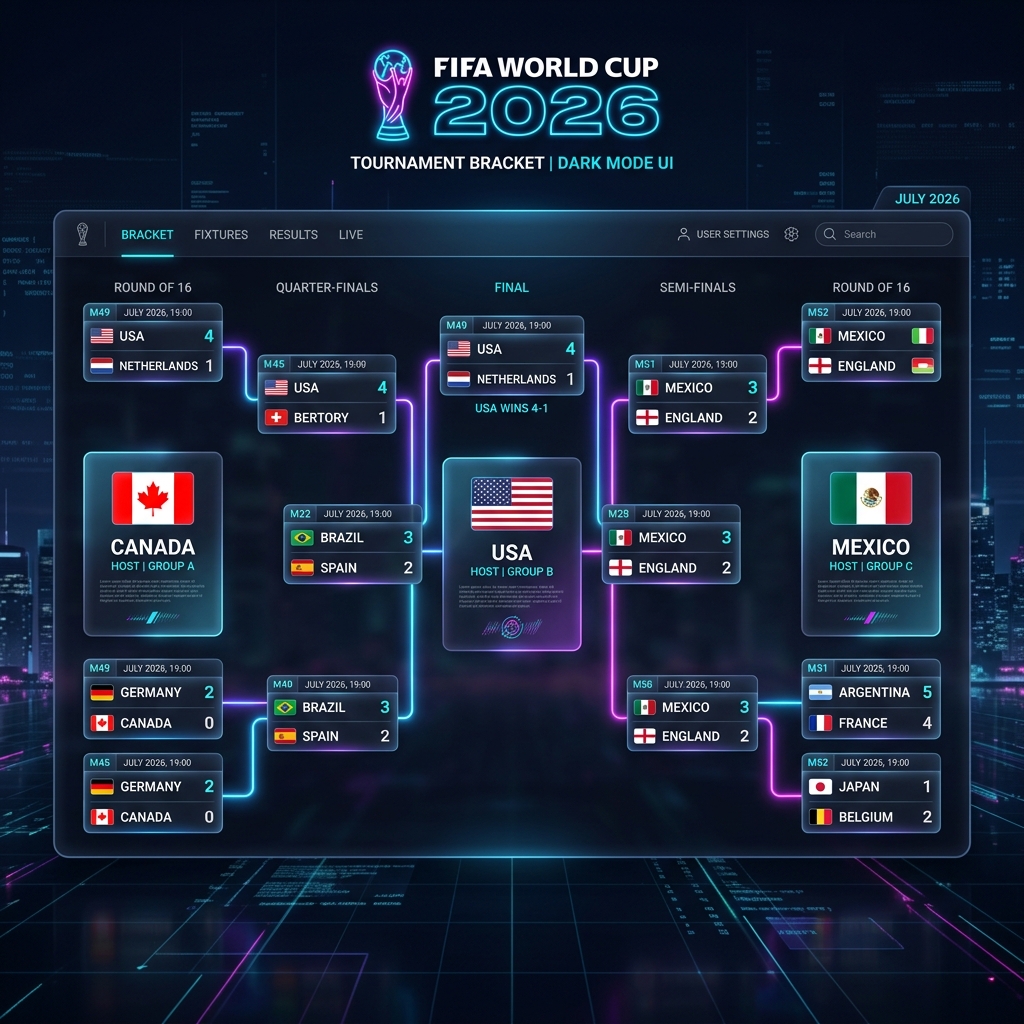
Instead of the traditional 32-team format, the 2026 tournament will host 48 nations, increasing the total match count from 64 to 104 games. This offers an enormous volume of betting opportunities over a 39-day window (June 11 – July 19, 2026).

  • Group Stage: Teams are divided into 12 groups of four.
  • Knockout Qualification: The top two teams from each group, along with the 8 best third-place teams, will advance to the newly introduced Round of 32.
  • Extended Knockout: One extra round is added to the knockout bracket, meaning a team must play 8 matches (instead of 7) to win the trophy.

2. Group Stage Math & The 3rd-Place Team Dynamics

The introduction of the "best third-place" rule creates unique game-theory scenarios in the third match of the group stage. Often, a team that has already qualified or is sitting on 3 points will play extremely defensively to preserve a draw or minimize their goal difference, as a goal difference of zero is typically enough to qualify as a top 3rd-place team. AI models analyze these motivation vectors to predict low-scoring matches and card counts, which are heavily overlooked by the public.

3. Host Nations & Crucial Travel Zones

Matches are distributed across three host nations, with the knockout matches concentrated in the United States:

  • United States (78 matches): Games will be hosted across 11 cities including Atlanta, Boston, Dallas, Houston, Kansas City, Los Angeles, Miami, New York/New Jersey (Final host), Philadelphia, San Francisco, and Seattle.
  • Mexico (13 matches): Group-stage and early knockout games will take place in Guadalajara, Mexico City (high altitude), and Monterrey.
  • Canada (13 matches): Host cities include Toronto and Vancouver.

4. Participating Teams & Key Player Data

Below is the complete list of the 48 qualifying and highly-probable nations competing in the 2026 World Cup, including the top three key players for each team. This squad data is critical for tracking individual player props, injury impacts, and expected goals (xG).

Country Top 3 Key Players
ArgentinaLionel Messi, Julian Alvarez, Enzo Fernandez
FranceKylian Mbappe, Antoine Griezmann, Eduardo Camavinga
BrazilVinicius Jr, Rodrygo, Alisson Becker
EnglandJude Bellingham, Harry Kane, Phil Foden
SpainRodri, Lamine Yamal, Pedri
GermanyJamal Musiala, Florian Wirtz, Leroy Sane
PortugalBruno Fernandes, Rafael Leao, Bernardo Silva
NetherlandsVirgil van Dijk, Xavi Simons, Cody Gakpo
ItalyNicolo Barella, Federico Chiesa, Gianluigi Donnarumma
CroatiaLuka Modric, Josko Gvardiol, Mateo Kovacic
BelgiumKevin De Bruyne, Jeremy Doku, Romelu Lukaku
UruguayFederico Valverde, Darwin Nunez, Ronald Araujo
USAChristian Pulisic, Weston McKennie, Folarin Balogun
MexicoEdson Alvarez, Santiago Gimenez, Guillermo Ochoa
CanadaAlphonso Davies, Jonathan David, Stephen Eustaquio
ColombiaLuis Diaz, James Rodriguez, Jefferson Lerma
JapanKaoru Mitoma, Takefusa Kubo, Wataru Endo
MoroccoAchraf Hakimi, Brahim Diaz, Yassine Bounou
SenegalSadio Mane, Kalidou Koulibaly, Nicolas Jackson
South KoreaSon Heung-min, Kim Min-jae, Hwang Hee-chan
SwitzerlandGranit Xhaka, Manuel Akanji, Breel Embolo
DenmarkChristian Eriksen, Rasmus Hojlund, Pierre-Emile Hojbjerg
EcuadorMoises Caicedo, Piero Hincapie, Kendry Paez
SerbiaAleksandar Mitrovic, Dusan Vlahovic, Sergej Milinkovic-Savic
PolandRobert Lewandowski, Piotr Zielinski, Wojciech Szczesny
IranMehdi Taremi, Sardar Azmoun, Alireza Jahanbakhsh
AustraliaMathew Ryan, Harry Souttar, Jackson Irvine
Saudi ArabiaSalem Al-Dawsari, Firas Al-Buraikan, Saud Abdulhamid
EgyptMohamed Salah, Omar Marmoush, Mahmoud Trezeguet
NigeriaVictor Osimhen, Ademola Lookman, Alex Iwobi
AlgeriaRiyad Mahrez, Ismael Bennacer, Ramy Bensebaini
MaliYves Bissouma, Amadou Haidara, Cheick Doucoure
Ivory CoastSebastien Haller, Franck Kessie, Simon Adingra
CameroonAndre Onana, Bryan Mbeumo, Frank Anguissa
GhanaMohammed Kudus, Thomas Partey, Inaki Williams
QatarAkram Afif, Almoez Ali, Meshaal Barsham
PeruGianluca Lapadula, Andre Carrillo, Pedro Gallese
ChileAlexis Sanchez, Ben Brereton Diaz, Arturo Vidal
VenezuelaSalomon Rondon, Yangel Herrera, Yeferson Soteldo
WalesBrennan Johnson, Harry Wilson, Ethan Ampadu
ScotlandAndrew Robertson, Scott McTominay, John McGinn
TurkeyHakan Calhanoglu, Arda Guler, Kenan Yildiz
UkraineMykhailo Mudryk, Artem Dovbyk, Oleksandr Zinchenko
HungaryDominik Szoboszlai, Milos Kerkez, Willi Orban
AustriaMarcel Sabitzer, Konrad Laimer, Marko Arnautovic
Czech RepublicPatrik Schick, Tomas Soucek, Vladimir Coufal
SwedenAlexander Isak, Dejan Kulusevski, Viktor Gyokeres
NorwayErling Haaland, Martin Odegaard, Alexander Sorloth

Types of AI Predictions

Types of AI Predictions Infographic

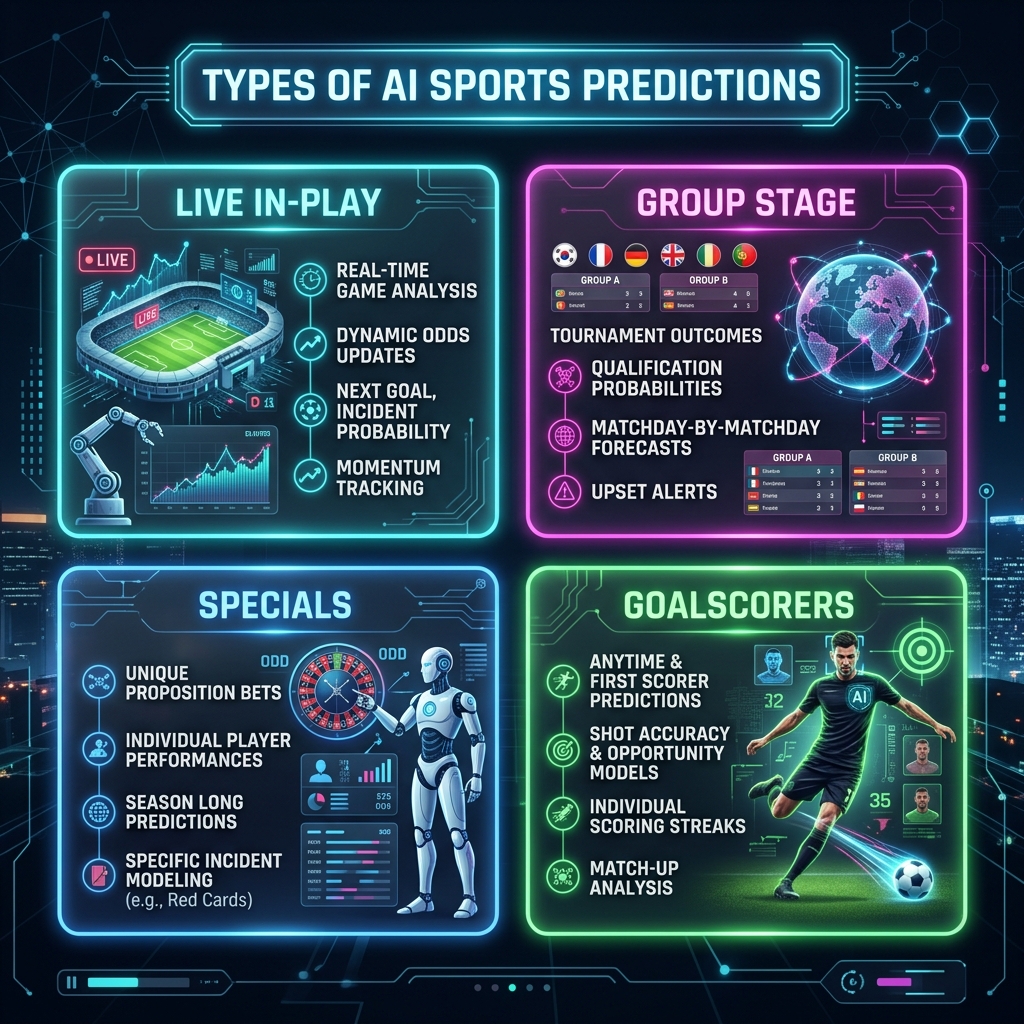
Predictive AI models for sports betting are not a one-size-fits-all solution. Different algorithms are engineered for different betting markets, ranging from high-frequency live in-play adjustments to long-term tournament path simulations. Understanding these categories allows bettors to pair the right tool with the right market.

1. Live In-Play Betting Algorithms

Live in-play betting has the highest volume of market inefficiencies, as bookmakers rely on automated mathematical decay models to update their odds. These decay models do not account for qualitative game state changes, such as a team shifting to a low block, a key defender showing signs of hamstring tightness, or tactical momentum swings.

AI models scrape live match feeds (possession, dangerous attacks, passes completed, player tracking) to predict live goals and corner counts, flagging +EV opportunities before the bookmaker's algorithms can adjust the line.

SportsBotAI

Best for live in-play predictions, real-time momentum tracking, and instant value alerts.

Visit SportsBotAI →

2. Group Stage Probabilities & Motive Vectors

Predicting the outcome of group-stage matches requires calculating joint probabilities of goal distributions (Bivariate Poisson models) combined with team motivation metrics. In the third match of a group stage, a team that only needs a draw to qualify has a different motivational factor than a team that must win by three goals.

Machine learning models simulate these motivations, identifying when traditional odds are overvaluing a favorite who has no incentive to push for a high-scoring win.

Leans.AI

Top tier group stage probability matrices, goal line distributions, and +EV leans.

Visit Leans.AI →

3. Player Props & Special Markets

Player props (shots on target, tackles, cards, anytime goalscorers) are highly vulnerable to AI exploitation. Because bookmakers focus their primary modeling resources on 1X2 and main Asian Handicaps, player prop lines are often soft. AI systems aggregate player data across their domestic leagues, compare their historical performance against the specific defensive style of their opponents, and calculate true prop probabilities.

SportsBotAI

Deep player prop analytics, shots on target models, and referee card betting overlays.

Visit SportsBotAI →

4. Lay Betting & Tournament Path Simulations

Lay betting (betting on what will not happen) is an extremely powerful technique on exchanges. For example, laying a highly-hyped favorite to reach the semi-finals can yield a massive ROI. To identify these opportunities, AI engines run Monte Carlo simulations (up to 100,000 runs) of the entire tournament bracket, mapping out every possible knockout pathway and identifying where the market's implied probability of a team reaching a certain stage is mathematically overstated.

Leans.AI

Advanced tournament simulations, bracket path models, and lay betting signals.

Visit Leans.AI →

Programmatic Predictions (+EV)

+EV Programmatic Betting Dashboard

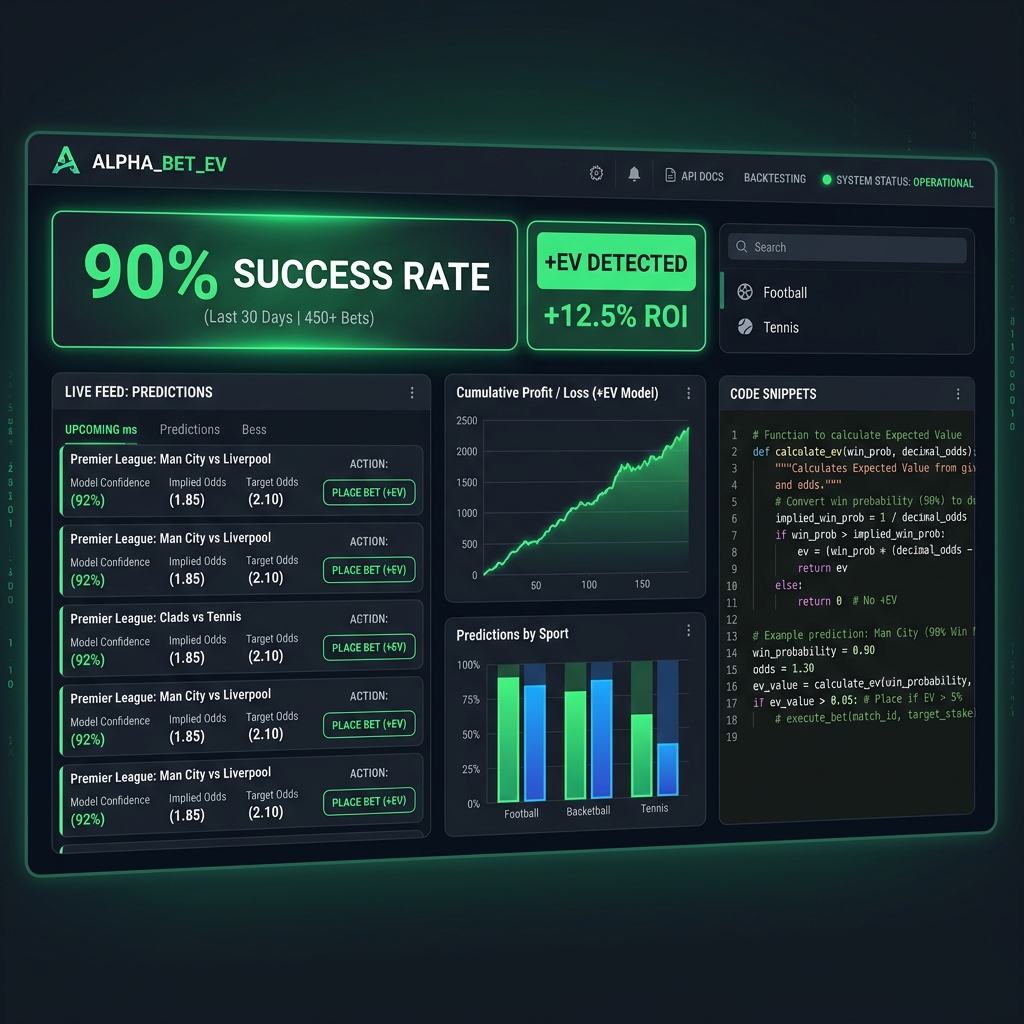
Programmatic betting represents the pinnacle of modern sports wagering. Rather than relying on gut feeling, programmatic systems leverage automated algorithms to scan multiple sportsbooks simultaneously, looking for pricing inefficiencies that yield a positive Expected Value (+EV). By executing bets only when the odds offered are higher than the true mathematical probability of the outcome, bettors turn gambling into a statistical investment portfolio.

1. The Mechanics of Expected Value (+EV)

Expected Value is the amount a bettor can expect to win or lose if they place the same bet on the same odds repeatedly. The mathematical formula is simple: EV = (Probability of Winning * Profit) - (Probability of Losing * Stake).

If the calculated Expected Value is greater than 0%, it is a +EV bet. While a human bettor takes minutes to calculate these equations and compare lines, automated APIs and AI scrapers perform this operation across thousands of markets in fractions of a second, highlighting exact value opportunities as they arise.

2. Scanning and Arbitrage Opportunities

During the World Cup, the sheer volume of matches, alternative handicaps, and player props creates thousands of pricing discrepancies across bookmakers. Programmatic tools connect directly to real-time sports data feeds, identifying where bookmakers disagree on odds or where a slow bookmaker has failed to adjust a line in response to news (like a sudden squad announcement or injury update). Sharp players use this data to execute arbitrage bets (guaranteeing a profit regardless of the match outcome) or value bets.

3. Our Featured Programmatic Partners

To run a successful programmatic betting setup for the 2026 World Cup, you need a high-speed scanner that supports your regional bookmakers, including US-regulated, European, offshore, and crypto-related platforms.

BetHeroSports

The richest & most powerful tool in the market. Scans over 400 bookmakers (including 60+ licensed US Bookies, all trusted Offshore sportsbooks, and crypto books). Perfect for US & international players.

Try BetHeroSports →

Leans.AI

Algorithmic +EV value signals powered by the 'Remi' neural network. Ideal for group stage spreads.

Try Leans.AI →

AI Predictions for Prediction Markets

Prediction Markets vs Odds

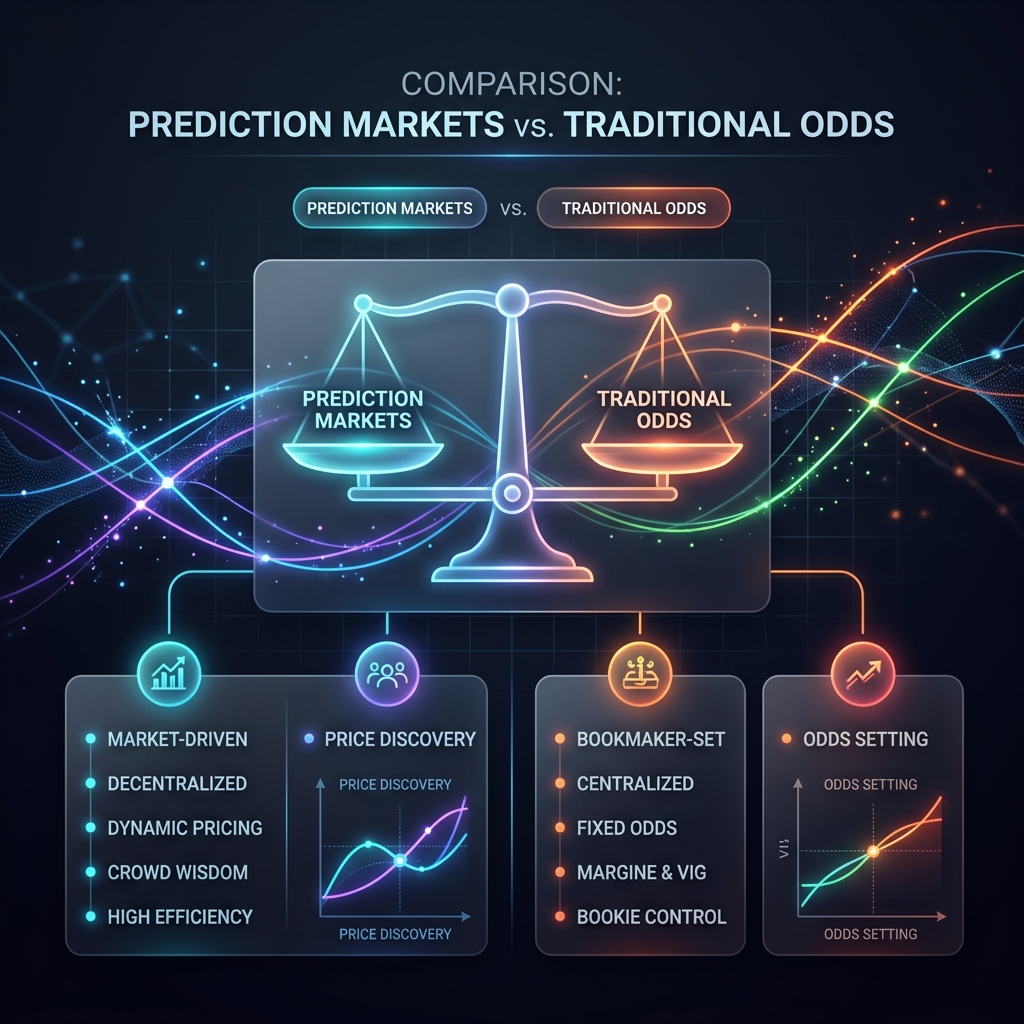
Prediction markets (like Polymarket, Kalshi, or Betfair Exchange) operate on a peer-to-peer structure, completely different from traditional sportsbooks. Instead of playing against a bookmaker's built-in margin, you are trading shares directly with other participants. The prices of these shares are determined entirely by market supply and demand, representing the collective 'wisdom of the crowd'.

1. Prediction Markets vs. Sportsbooks

Because there is no house margin (vigorish) baked into exchange contracts, prediction markets often represent much higher value for bettors than standard bookmakers. If the crowd believes Argentina has an 80% chance of advancing, shares will trade at $0.80. If your AI model calculates the true probability at 88%, buying those shares represents a highly profitable +EV investment. Furthermore, you can trade these positions dynamically—buying shares early and selling them during the match as momentum shifts.

2. Wisdom of the Crowd vs. Mathematical Bias

The crowd is not always wise. During high-profile events like the World Cup, prediction markets are flooded with recreational capital and emotional traders. News events, viral social media posts, and public narratives cause massive overreactions, leading to dramatic price spikes and crashes. AI models ignore the news hype, focusing purely on cold, hard player data, tactical history, and simulated tournament runs to buy undervalued shares or lay overvalued options.

3. Strategic Simulation Models for Prediction Trading

To capture value in prediction markets, you need an AI tool capable of running thousands of tournament simulations to find discrepancy points between the trading price of a contract and its true probability.

PredictionHunt

The ultimate AI tool for dominating prediction markets. Scans, tracks, and isolates massive inefficiencies in P2P prediction contracts.

Join PredictionHunt →

AI Predictions Success Rate

AI Model Success Rate Chart

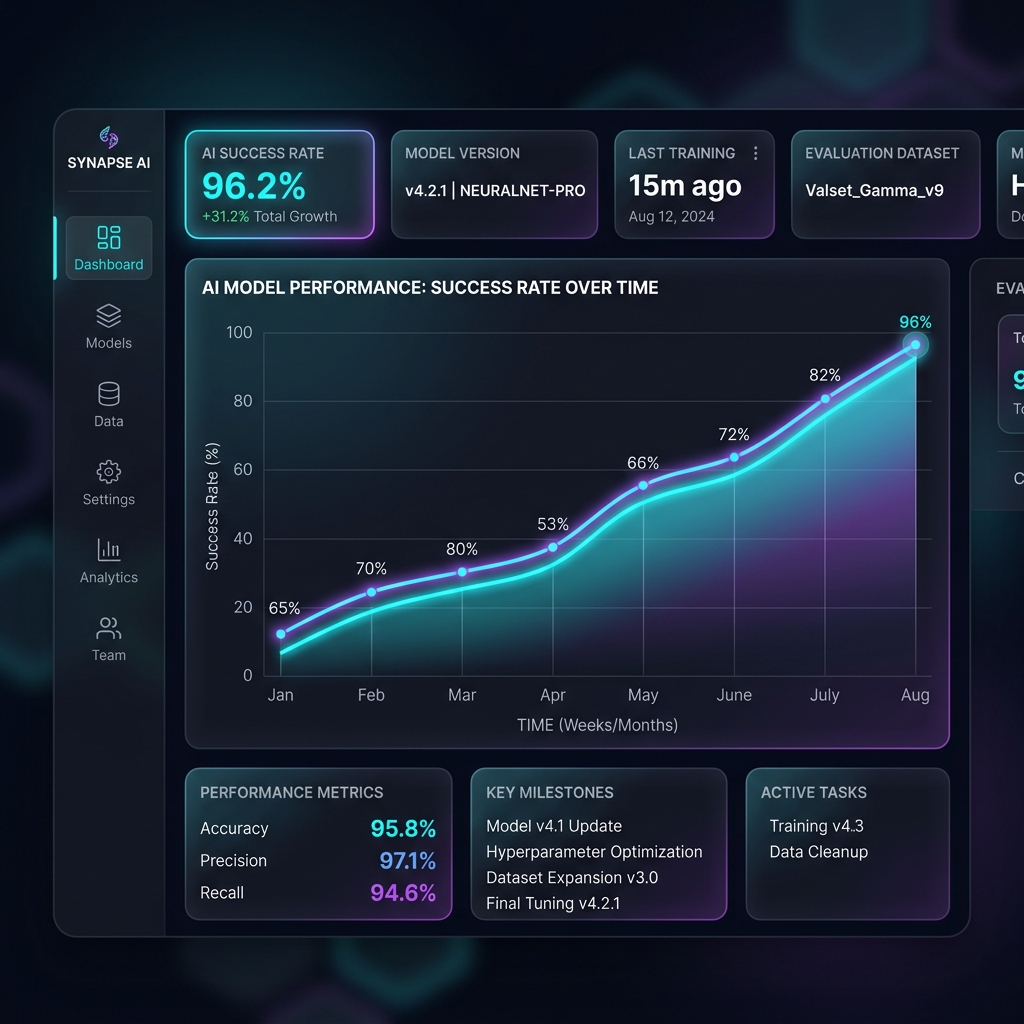
When evaluating the success rate of AI prediction models, it is crucial to separate marketing hype from professional sports betting reality. No model will win 95% of its main-market bets over a large sample size. In sports betting, the key metric is not the sheer percentage of won bets, but rather the overall Yield (Return on Investment) generated over a season.

1. Understanding Win Rate vs. Yield (ROI)

A model that boasts a 90% win rate on bets with odds of 1.05 will lose money in the long run if a single upset wipes out 20 wins of profit. Conversely, a professional AI model targeting +EV selections on Asian Handicaps or player props at odds of 2.10 only needs a 52.4% win rate to break even, and a 55% win rate to generate a phenomenal return.

Most elite sports betting AI systems aim for a sustained 5% to 8% Yield (ROI) over thousands of bets. During a tournament like the World Cup, the target is to exploit the temporary line distortions caused by recreational money to capture a high yield over the 104-match schedule.

2. Backtesting and Validation Methodologies

How do we know if an AI model is reliable? The answer lies in rigorous backtesting. Before a model is deployed for the 2026 World Cup, it is trained on historical data from the 2014, 2018, and 2022 World Cups, alongside thousands of qualifying and domestic matches. By comparing the AI's predicted probabilities against historical closing odds and actual results, developers tune hyperparameters to prevent "overfitting" (creating a model that looks perfect on paper but fails in real-world scenarios).

3. Bankroll Management & The Kelly Criterion

Even the most advanced AI model will fail without proper bankroll management. Because sports betting always involves variance, bettors must size their wagers mathematically based on the strength of their edge. Professional setups implement the Kelly Criterion to size bets dynamically:

Bet Size Percentage = (Implied Odds * True Probability - 1) / (Implied Odds - 1)

By automating your bet sizing according to the Kelly Criterion and the AI's calculated true probability, you protect your bankroll during cold streaks and maximize profit during hot runs, turning sports betting into a disciplined, programmatic investing system.

Frequently Asked Questions (FAQ)

World Cup FAQ

Below are 30 of the most frequently asked questions regarding AI predictions, software, and strategies for the 2026 World Cup.

1. How does AI predict World Cup 2026 matches?

AI models scrape thousands of player and team data points (such as xG, progressive passes, recovery rates, and team shape) and run Monte Carlo simulations to estimate the true probability of match outcomes, bypassing media hype and emotional public biases.

2. Why is the 48-team format better for AI sports betting?

The expansion from 32 to 48 teams introduces lower-ranked teams with little historical data. Casual bettors have no idea how these squads match up, causing bookmakers to create soft, mispriced lines that AI models exploit instantly.

3. How does travel fatigue affect the 2026 World Cup AI models?

With matches played across three massive countries (USA, Canada, Mexico), travel logistics are grueling. AI models factor in total flight hours, time zone changes, and rest days to calculate player fatigue and performance decay curves.

4. What is the difference between a trend model and an expected value (+EV) model?

A trend model looks at historical patterns (e.g., "team X wins 80% of home games"). A +EV model calculates the mathematical edge by comparing the AI's calculated probability against the implied probability of a bookmaker's odds.

5. Which AI betting tool is best for live in-play predictions?

SportsBotAI is highly optimized for live in-play wagering, tracking real-time match events and sending immediate momentum shift alerts to catch mispriced live odds.

6. Does altitude in Mexico City affect player performance predictions?

Yes. Playing at an altitude of 7,200 feet in Mexico City decreases oxygen levels, accelerating player fatigue. Advanced AI models factor in altitude and recovery times, particularly for high-intensity pressing teams.

7. What are the best player props to target with AI?

Shots on target, player fouls, and anytime goalscorer markets represent the highest value. Bookmakers spend less resource pricing these prop lines, making them much softer than main-market handicaps.

8. How does AI handle the new 32-team knockout round?

The extra knockout round increases variance. AI handles this by simulating millions of bracket pathways to identify laying opportunities on teams that the market overvalues to reach the final.

9. Is BetHeroSports available for US players?

Yes. BetHeroSports is fully optimized for the US market, scanning over 60 licensed US bookies alongside offshore and crypto sportsbooks.

10. How many bookmakers does BetHeroSports scan?

BetHeroSports scans over 400 bookmakers globally, including major US sportsbooks, European books, trusted offshore platforms, and crypto-related betting sites.

11. What is the difference between SportsBotAI and Leans.AI?

SportsBotAI specializes in real-time tracking, live in-play alerts, and detailed player prop markets. Leans.AI uses the "Remi" neural network to output probability weights and bracket simulations for pre-match bets.

12. Why do casual fans skew World Cup betting lines?

Casual fans bet based on emotion, backing heavy favorites (e.g. Brazil or Argentina) or famous players. This creates artificial public bias, inflating the odds of underdogs and opposing handicaps.

13. How does lay betting work for the World Cup?

Lay betting (available on exchanges) means betting that an event will NOT happen (e.g. laying France to win the group). AI models use simulations to spot overhyped favorites that have a high statistical chance of failing.

14. Can I use AI to automate my bets programmatically?

Yes. Programmatic tools connect to sportsbooks via API, executing bets instantly when +EV opportunities are found, allowing for automated, hands-free betting portfolio management.

15. What ROI can I realistically expect from World Cup AI models?

Elite sports betting models generate an average long-term Yield (ROI) of 5% to 8%. Any system promising 50% or 100% ROI is highly risky or fraudulent.

16. How does AI adjust for player injuries during the tournament?

AI models recalculate team strength metrics dynamically when a key player is injured, mapping the replacement player's stats (e.g. progressive passes, interceptions) to adjust team expectations.

17. What is the Kelly Criterion and why is it used?

The Kelly Criterion is a mathematical formula that sizes your bets according to the strength of your edge. It prevents bankroll ruin during losing streaks and maximizes growth during winning streaks.

18. Are prediction markets like Polymarket better than traditional sportsbooks?

Yes. Prediction markets are peer-to-peer and do not have bookmaker margins built in. However, they are highly sensitive to public news hype, which AI models exploit by buying undervalued shares.

19. How does AI handle head-to-head history?

AI models generally down-weight head-to-head match history from years past, as squad compositions and tactics change. Instead, they focus on recent performance, current player rosters, and tactical match-ups.

20. Does weather affect AI match outcome predictions?

Yes. High heat and humidity degrade performance, especially for teams playing high-pressing styles. AI models factor in weather reports to predict lower goal totals and slower game paces.

21. What is the Bivariate Poisson model in football betting?

It is a statistical model used to calculate the probability of exact scores (e.g., 2-1, 1-0) by estimating the attacking and defensive strengths of both teams and accounting for home-field correlation.

22. How does AI factor in referee behavior (cards/fouls)?

AI systems scrape referee statistics (average cards per game, fouls called per tackle) and match them against team aggressive indices to find +EV value on card markets.

23. Why is group stage motivation crucial in the 3rd match?

In the final group game, a team that has already qualified may bench key starters to avoid injury, whereas their opponent might need a win to survive. AI models prioritize motivation variables over historical team ratings.

24. What is closing line value (CLV)?

CLV is the value of your bet compared to the odds right before the match starts. Beating the closing line consistently is the strongest indicator of a profitable long-term betting strategy.

25. Is there a free trial for BetHeroSports?

Yes, BetHeroSports provides entry trials so that players can test the software's scanning capability and UI before purchasing a full subscription.

26. How do I get started with live in-play sports betting bots?

You can start by using SportsBotAI to receive real-time alerts. Once comfortable, you can integrate with automated execution software via webhooks to place live bets instantly.

27. Do sportsbooks ban players who use AI?

Sportsbooks do not ban you for using AI, but they will limit accounts that consistently beat the closing line or exploit arbitrage windows. Using betting brokers helps bypass these limits.

28. How does travel fatigue vary across the host nations?

Teams playing matches in the Pacific Northwest (e.g., Vancouver/Seattle) and traveling to the East Coast (e.g., Miami/New York) suffer significantly more fatigue than teams clustered in regional hubs.

29. What data sources do sports betting APIs provide?

They provide historical odds, live streaming odds, player performance statistics, xG datasets, and direct sportsbook settlement feeds.

30. Can AI predict penalty shootouts in the knockout stages?

Yes. AI models analyze goalkeeper save histories (direction bias) and striker penalty conversion data to calculate probability outcomes if a knockout match goes to penalties.